
Cabinet Painting & Kitchen Cabinet Refinishing in Arvada, CO
A factory-smooth sprayed finish for a fraction of what new cabinets cost. Most cabinet refinishes don't fail from bad paint — they fail from grease that was never fully cleaned off. Here's exactly what goes into ours, layer by layer.
Our Cabinet Painting Process: Five Layers to a Factory-Smooth Finish
A cabinet refinish that peels within a year almost always skipped the same step: real degreasing. Scroll through exactly what goes into ours, from prep and repairs to primer and the final finish coats.
Layer 01 · Existing Cabinets
Layer 01
Existing Cabinets
Every job starts with doors and drawer fronts removed and hardware pulled, and an honest look at the wood underneath — dents, water damage, worn edges. What we find here decides how much repair the next four layers need.
Layer 02
Clean & Degrease
Years of cooking oil and residue sit on kitchen cabinets even when they look clean, and that film is the single biggest reason a new finish fails to bond. Every surface gets cleaned with a real degreaser and given time to dry completely before anything else happens.
Layer 03
Sand & Fill
Every surface gets scuff-sanded so the new finish has something to grip, then dents, holes, and worn edges get filled and smoothed. Skipping the scuff-sand is how a "new" finish starts chipping at the corners within months.
Layer 04
Bonding Primer
A bonding primer made for cabinet-grade adhesion goes on next — regular wall primer isn't built to hold up to the daily handling and cleaning a kitchen cabinet actually gets, and skipping this step is where most DIY refinishes go wrong. Where the wood calls for it, such as tannin-rich oak or a dark stain under a light color, we use a stain-blocking primer so nothing bleeds through.
Layer 05
Sprayed Finish Coats
Two to three thin coats of a durable cabinet enamel, such as Sherwin-Williams Emerald Urethane Trim Enamel where it suits the job. Doors and drawer fronts are sprayed where practical for a smooth, consistent finish, while cabinet frames and other fixed surfaces are finished with the application method that suits the kitchen and the coating system. Doors and drawers are left to dry and harden before hardware goes back on and everything is reassembled.
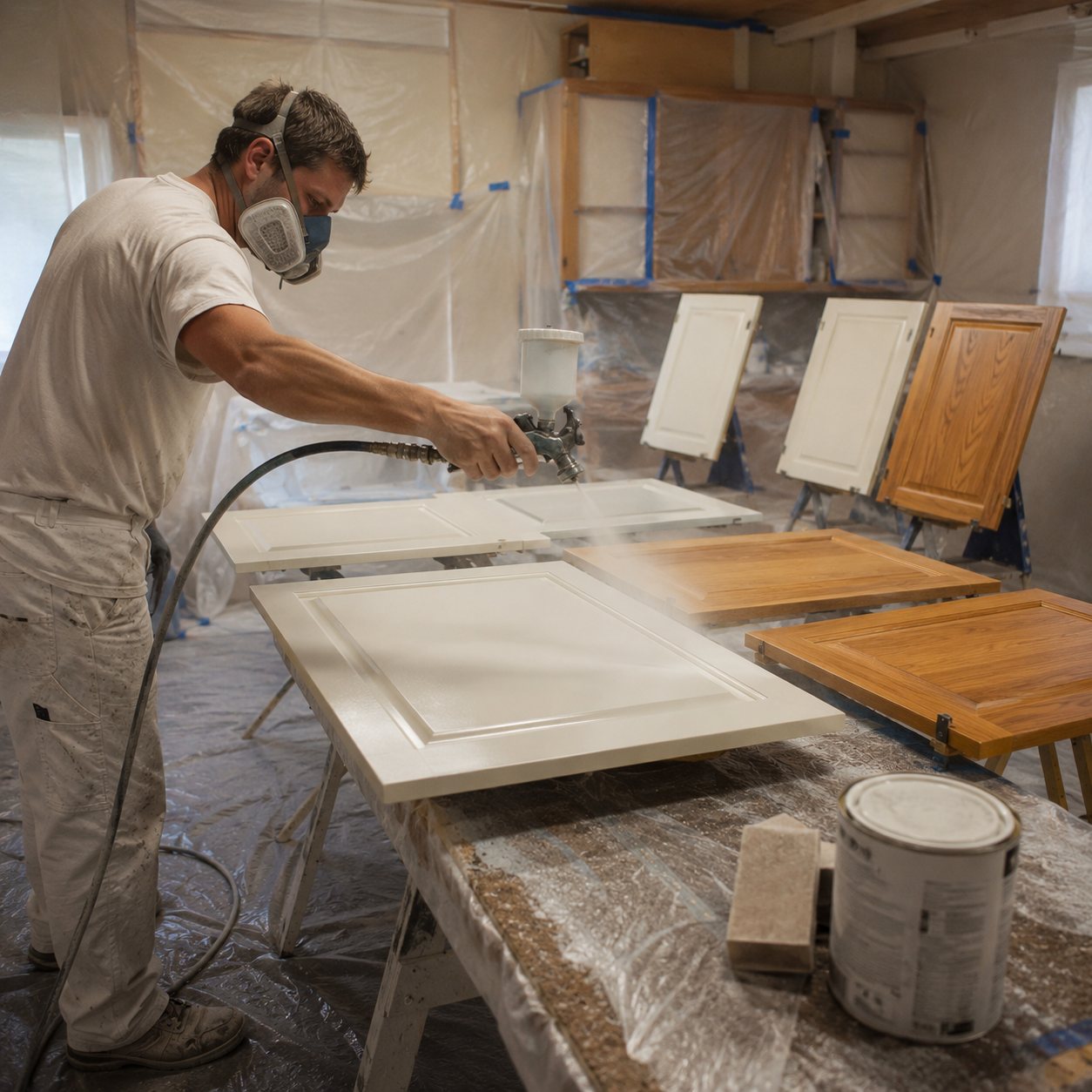
Illustrative example: this AI-generated image demonstrates part of the cabinet refinishing process. It is not a photo of an Arvada PaintWorks project.
Kitchen Cabinet Painting, Refinishing & Restoration
A fraction of the cost of full replacement, when your cabinet boxes are still solid.
Cabinet painting and cabinet refinishing are two names for the same job: we keep your existing doors, drawer fronts, and boxes and build a brand-new finish on top of them. For worn kitchen cabinets with scuffed edges, faded stain, or old dents, that work doubles as a restoration, since repairs are part of the prep. We offer it alongside our other painting services across Arvada and the nearby Denver metro, and it covers far more than the kitchen.
Cabinet Painting vs. Refacing vs. Replacing in Arvada, CO
If your cabinet boxes are solid, professional cabinet painting is usually the most practical way to update an Arvada kitchen. Here’s how the three options compare, so you can choose the right one for your house.
Cabinet Painting (Refinishing)
Refinishing keeps your existing doors, drawer fronts, and boxes and rebuilds the finish on top of them: degrease, scuff-sand, prime, and apply durable finish coats, with doors and drawer fronts sprayed where practical. It’s the right call when the layout works and the wood is sound but the color or finish looks tired. It’s also the least disruptive option, because your countertops and layout stay exactly as they are.
Refacing
Refacing swaps in new doors and drawer fronts and wraps the cabinet boxes in veneer or laminate. It can change the door style itself, which paint can’t do. The trade-off is more material, a longer lead time, and a higher price than refinishing, so it only pays off if you truly dislike your current door profile. Refacing is a separate specialty we don’t offer, but we’ll tell you honestly if it suits your kitchen better than paint.
Full Replacement
Replacement is the answer when boxes are water-damaged, sagging, or coming apart, or when you’re changing the kitchen layout. It also means demolition, often new countertops, and a stretch of weeks without a working kitchen. If the structure is sound, it’s rarely necessary.
How We Decide What Your Cabinets Need
At your free estimate we look at three things: the condition of the boxes, the style of the doors, and the finish that’s on them now. Swollen particleboard under the sink or beside the dishwasher is the most common deal-breaker, because a new finish can’t fix a box that has already failed. If refinishing isn’t the right fit for your kitchen, we’ll tell you plainly rather than sell you a job that won’t last. To see what does and doesn’t change during a refinish, read our cabinet painting before-and-after guide.
Because the layout stays put, cabinet refinishing also pairs easily with fresh walls and trim. If the rest of the room is due for an update, ask about bundling it with our interior painting service, or request a free estimate and we’ll look at both at once.
Oak, Maple, MDF & Laminate: Which Cabinets Can Be Refinished
Most kitchen cabinets can be painted, but each material needs its own prep. Here’s what we do differently for each one.
Oak Cabinets
Oak has a deep, open grain that telegraphs through paint if it isn’t addressed. For a smooth, modern look we fill the grain before priming. If you like some texture, we can skip that step and keep a hint of the wood showing through. It’s a style choice, and we’ll walk through it with you.
Maple, Birch & Cherry
Tight-grained hardwoods take a sprayed finish beautifully and need less filling. Older, darker stains can bleed through a light color, so a stain-blocking bonding primer is part of the plan when you’re going from a dark finish to white or a pale neutral.
MDF & Paint-Grade Doors
Many newer kitchens use MDF center panels or paint-grade doors. They spray very smooth, but cut edges soak up primer and swell if they get wet, so the edges are sealed carefully before color goes on.
Laminate & Thermofoil
These surfaces are slick and non-porous, so they demand thorough degreasing, scuff-sanding, and a true bonding primer. Thermofoil that is already peeling, bubbling, or lifting near the stove or dishwasher usually can’t hold a new finish, and we’ll say so before you spend anything.
Why Colorado’s Dry Air Matters for Cabinet Finishes
Indoor humidity along the Front Range can drop low in winter, and wood cabinets expand and contract with the seasons. Finishes that were rushed or applied over a dirty surface are the ones that crack at the seams and peel at the edges. That’s why we spend the time on degreasing, scuff-sanding, and cabinet-grade primer and enamel instead of shortcuts. It’s also the reason we remove doors and drawer fronts and finish every edge, not just the faces you see most.
Primers & Durable Cabinet Coatings We Use
Kitchen cabinets get grabbed, bumped, and wiped down every day, so the products matter as much as the prep.
Bonding & Stain-Blocking Primers
A bonding primer gives the finish coats something solid to grip, especially on slick factory finishes, laminate, and previously varnished wood. On tannin-rich oak, or when a dark stain is going light, we use a stain-blocking primer so yellow or brown tones don’t bleed into your new color.
Urethane-Modified Cabinet Enamel
Where appropriate, we use professional-grade Sherwin-Williams coatings such as Emerald Urethane Trim Enamel, a urethane-modified enamel made for doors, trim, and cabinets. It levels out smoothly and cures to a hard, durable finish that stands up to scuffs and frequent cleaning. We match the product to your cabinets rather than using one paint for every job.
A Professional Sprayed Finish
Doors and drawer fronts are laid flat and sprayed where practical to produce a smooth, consistent finish. Spraying lays down thin, even coats without brush marks, which is what gives professionally painted cabinets their factory-smooth look. Cabinet frames and other fixed surfaces are finished in place, with careful masking around counters, walls, and appliances, using the application method that fits the kitchen and the coating system.
Cabinet Colors, Sheen & Hardware: Getting the Finished Look Right
Color is only half of how refinished kitchen cabinets look. Sheen and hardware do the rest.
White & Light Cabinets
White and soft neutrals remain the most requested kitchen cabinet colors because they brighten a room and pair with almost any countertop. Pure bright whites can look stark against warm counters or wood floors, so we encourage you to look at samples in your own kitchen light before choosing.
Two-Tone & Dark Cabinets
A common approach is a darker color on the lower cabinets or an island with lighter uppers. Deep greens, navy, and charcoal look striking but show dust, fingerprints, and chips more than light colors do, so expect to wipe them down more often.
Choosing a Sheen
Cabinet enamel is usually finished in satin or semi-gloss. Higher sheens clean up easily but highlight surface flaws and wear, while lower sheens hide imperfections and read as more modern. We’ll help you pick based on how hard your kitchen works.
Hardware, Hinges & Pulls
New pulls and knobs are one of the cheapest ways to make a refinish feel like a remodel. If your new hardware matches the existing hole spacing, there’s nothing to patch. If it doesn’t, we fill and sand the old holes before priming. Worn or rusted hinges are worth replacing while the doors are off.
Not sure which direction to go? Bring a swatch or a photo to your estimate, or tell us about your countertops and flooring and we’ll point you toward colors that work.
What Affects the Cost of Cabinet Painting
Every kitchen is different, so we price cabinet painting and refinishing from a free estimate rather than a flat rate. These are the factors that move the number.
Doors, Drawers & Boxes
The number of doors, drawer fronts, and cabinet boxes is the biggest driver, since every piece is cleaned, sanded, primed, and finished.
Condition & Repairs
Chipped edges, dents, water damage, and loose joints add repair and filling time before any primer goes on.
Wood Species & Grain
Open-grain oak needs grain filling for a smooth, modern look. Maple, MDF, and laminate each need their own prep and primer.
Color Change
Light over a dark stain usually means a stain-blocking primer and sometimes an extra coat. Dark over light typically covers more easily.
Cabinet Interiors
Painting the inside of the boxes and shelves adds surface area. Many homeowners leave interiors as they are, and we can price it either way.
Islands, Vanities & Built-Ins
A kitchen island, bathroom vanities, laundry cabinets, or built-in shelving can join the same project and color plan.
Hardware Changes
If new pulls don’t match the old hole spacing, the old holes are filled and sanded and new ones drilled. Hinge swaps add a little time too.
Finish Level & Sheen
Higher sheens show every flaw, so they call for more meticulous prep than a forgiving satin, and grain filling or extra coats add time as well.
The quickest way to a real number is a free cabinet painting estimate. Call (303) 732-8347 or request your free estimate online, and we’ll look at your kitchen and give you a clear scope and price before any work starts. Curious about the quality of our work? Browse our recent painting projects.
What to Expect: Preparing Your Kitchen & the Refinishing Process
Cabinet painting is a multi-day project, but you’ll know the plan before it starts.
Before We Arrive
Empty the cabinets and drawers so every door and drawer front can come off, and clear the countertops near the work. We protect floors, counters, and appliances, and we mask what stays in place. Plan on a simplified kitchen routine for a few days, since the cabinet boxes are open while they’re being prepped.
- Remove food, dishes, and anything stored in cabinets and drawers.
- Clear countertops and the floor space in front of the cabinets.
- Decide on hardware and color before work begins so nothing delays the schedule.
Doors Off, Prepped, and Sprayed
Doors and drawer fronts are removed, laid flat, and sprayed where practical to produce a smooth, consistent finish. Cabinet frames and other fixed surfaces are cleaned, sanded, primed, and finished in place, using the application method appropriate for the specific kitchen and coating system. How many days this takes depends on the number of cabinets, the condition of the existing finish, and the number of coats, and your estimate will lay out the schedule for your kitchen.
Drying, Curing & Reinstall
Paint can feel dry within hours, but cabinet enamel typically keeps hardening for days to a few weeks afterward. We reinstall doors and hardware only once the finish is ready to handle, and we’ll give you simple care tips for the first weeks, like avoiding harsh cleaners and not taping anything to the new surface.
Bathroom Vanities & Built-Ins Too
The same cabinet painting process works on bathroom vanities, laundry cabinets, and built-in shelving. Bathrooms add moisture, so we pay extra attention to sealing edges and use a durable cabinet enamel. If you’re updating a whole house, we can coordinate cabinets with interior painting for walls and trim. For offices and other business spaces, see our commercial painting services.
Cabinet Painting in Arvada & Nearby Denver Metro Cities
Based in Arvada, CO, with cabinet projects throughout Jefferson & Adams County communities.
Looking for kitchen cabinet painters near you? We handle cabinet refinishing and sprayed cabinet finishes for homeowners in Arvada, Wheat Ridge, Golden, and Lakewood, as well as Westminster, Broomfield, Thornton, and the wider Denver metro. If your cabinets are what’s dating the kitchen, the exterior may be next, so ask about our exterior painting too. To schedule a free cabinet refinishing estimate anywhere in our service area, call Arvada PaintWorks at (303) 732-8347.
Arvada
Our home base — cabinet painting in every neighborhood.
Westminster
Kitchen cabinets, vanities & interiors.
Wheat Ridge
Cabinet refinishing & interior painting.
Golden
Kitchen cabinets, vanities & interiors.
Broomfield
Cabinet refinishing & interior painting.
Lakewood
Kitchen cabinets, vanities & interiors.
Thornton
Cabinet refinishing & interior painting.
Don't See Your City?
Ask us — we regularly travel across the metro.
Cabinet Painting & Refinishing FAQs
Is cabinet painting the same as cabinet refinishing?
In most cases, yes. Homeowners use both terms for the same job: degreasing, sanding, priming, and applying a new cabinet enamel over your existing doors, drawer fronts, and boxes. Our cabinet refinishing is a painted finish: cleaning and degreasing, sanding or deglossing, the right primer for your cabinets, and professional finish coats, with doors and drawer fronts sprayed where practical, using Sherwin-Williams Emerald Urethane Trim Enamel where appropriate. We don’t strip and re-stain cabinets, and refacing and replacement are different services altogether.
What affects the cost of cabinet painting in Arvada?
The main factors are the number of doors, drawer fronts, and cabinet boxes; the condition of the cabinets and any repairs; the wood species and whether oak grain needs filling; the color change; whether interiors, islands, vanities, or built-ins are included; hardware changes; and the finish level and sheen. We give every project a free, no-pressure estimate so you know the exact scope and price before any work starts.
Should I paint, reface, or replace my kitchen cabinets?
If your cabinet boxes are solid and you like the door style, painting (refinishing) is usually the simplest and most affordable route, often at a fraction of the cost of replacement. Refacing makes sense if you want a different door style; it's a specialty we don't offer, but we'll tell you if it's the better fit. Replacement is for damaged boxes or a new layout. At your free estimate we'll check the condition of the boxes and tell you honestly which option fits.
How long does a cabinet painting finish last?
With thorough degreasing, proper priming, and a durable cabinet enamel, a professionally applied finish typically lasts 5 to 10 years or more with normal care. How well it holds up depends on how hard the kitchen is used and how gently it's cleaned. Our work is also backed by a 2-year workmanship warranty.
What paint do you use on kitchen cabinets?
We start with a cabinet-grade bonding primer, switching to a stain-blocking primer on oak or dark stains, and finish with a durable enamel. Where appropriate, we use professional-grade Sherwin-Williams coatings such as Emerald Urethane Trim Enamel, a urethane-modified enamel that cures to a hard, smooth finish. We choose the exact products based on your cabinet material and the look you want.
Do you spray or brush the finish?
Doors and drawer fronts are sprayed where practical to produce a smooth, consistent finish. Brushing or rolling tends to leave visible strokes on cabinet doors, which is why brushing or rolling them is not our normal process. Cabinet frames and other fixed surfaces are finished using the application method appropriate for the specific kitchen and coating system.
Can you paint oak cabinets so the grain doesn't show?
Yes. Oak has an open grain that shows through paint, so for a smooth look we fill the grain before priming. If you like some wood texture, we can leave it, and a hint of the grain will remain visible under the finish.
Can you paint laminate or thermofoil cabinets?
Often, yes. These slick surfaces need thorough degreasing, scuff-sanding, and a bonding primer made to grip non-porous materials. Thermofoil that is already peeling, bubbling, or lifting won't hold a new finish, and we'll tell you that at the estimate.
How long until I can use my kitchen after cabinets are painted?
Cabinet enamel can feel dry within hours but typically keeps curing for days to a few weeks, depending on the coating and conditions. You can generally use the kitchen once doors are rehung, but treat the surface gently at first: no harsh cleaners, no tape, and no heavy scrubbing.
Do you offer cabinet painting outside Arvada?
Yes. We're based in Arvada and also paint and refinish cabinets in Westminster, Wheat Ridge, Golden, Broomfield, Lakewood, Thornton, and across the wider Denver metro. Arvada PaintWorks is licensed, insured & bonded; call (303) 732-8347 for a free estimate.
Get a Free Cabinet Painting Estimate
Tell us about your kitchen and we'll tell you exactly what your cabinets need. Call (303) 732-8347 or request your free, no-pressure estimate online.