
Deck Staining in Arvada, CO, Built for Colorado's Sun.
Most deck stains don't fail from bad product — they fail because the wood was never properly cleaned and prepped first. Here's exactly what goes into ours, layer by layer.
Five Layers Between Your Deck and Colorado's Sun
At our elevation, UV runs 25 to 30% stronger than at sea level — that's what actually breaks a stain down early. Scroll through exactly what goes into ours.
Layer 01 · Existing Deck
Layer 01
Existing Deck
Every deck starts with an honest look at the wood — graying, splintering boards, popped nails, any soft spots that could mean rot underneath. A quick water test tells us whether the old finish is still protecting the wood or has already broken down.
Layer 02
Clean & Strip
We pressure wash to clear dirt, mildew, and loose fibers, and strip any old stain or sealer that's failing rather than staining over it. New stain applied over a failing old coat just peels along with it within a season.
Layer 03
Sand & Repair
Rough, splintering boards get sanded smooth, and any damaged or rotted wood gets repaired or replaced before staining. Stain protects wood — it doesn't fix structural problems, and covering up damage just hides it until it gets worse.
Layer 04
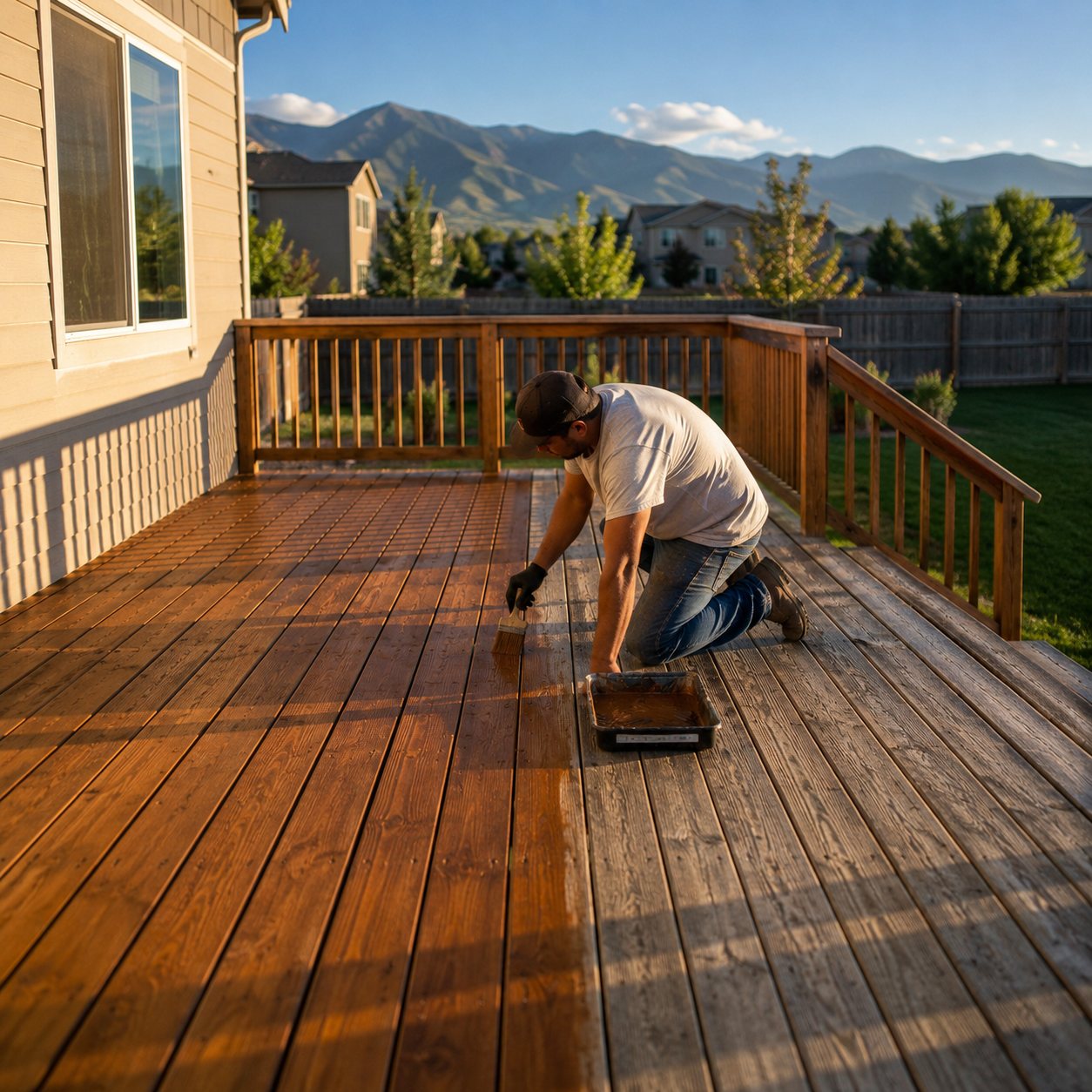
Stain Base Coat
The base coat penetrates the wood grain rather than just sitting on top of it, which is what lets Colorado's dry air and freeze-thaw cycles pass through the wood without the finish cracking and peeling early.
Layer 05
Protective Topcoat
A UV- and weather-resistant topcoat seals it all in — the layer doing the most work against the Front Range's intense high-altitude sun, which fades and breaks down an unprotected finish faster here than almost anywhere else in the country.
Every Deck Project We Cover
Deck staining, repair and refinishing, built for the wear Colorado's climate puts on a deck.
Choosing a Deck Stain: Transparent, Semi-Transparent or Solid
The stain you pick changes how your deck looks, how it ages, and how much work the next round of deck staining will be.
In Colorado's high-altitude sun, pigment matters. It’s the part of a deck stain that absorbs UV light before it reaches the wood, so the three main types of deck stain behave very differently on a south-facing Arvada deck than they would near the coast. Here’s how they compare.
Transparent Stain
Adds a light tint and shows the most natural wood grain. With very little pigment to block UV, it typically needs refreshing most often, so it suits newer, evenly colored wood and homeowners who don’t mind frequent touch-ups.
Semi-Transparent Stain
The most popular pick for cedar, redwood and pressure-treated decks. Enough pigment to add color and UV protection while the grain stays visible, and because it soaks in rather than forming a film, it fades gradually instead of peeling.
Solid Stain
The closest to paint. It hides graying, color variation and mismatched boards, and gives the strongest UV resistance. The trade-off is that a film finish can eventually wear or peel, and returning to a natural look later means stripping it.
Deck stain vs. deck paint vs. sealer
A clear sealer repels water but offers little UV protection, so boards tend to gray quickly at our elevation. Deck paint sits entirely on top of the wood and has to flex as boards swell and shrink through Colorado’s freeze-thaw swings, which is why painted floor boards so often crack and peel. A quality penetrating stain gives you color, UV protection and water resistance without a thick film to fail. Not sure which deck stain fits your deck? We’ll look at the wood’s age and condition during your free estimate and recommend a stain type to match how you want it to look. If the siding, trim or posts around your deck need paint rather than stain, our exterior painting service covers the rest of the house.
When to Restain a Deck: Signs Your Arvada Deck Needs It
Waiting too long is what turns routine deck maintenance into full deck restoration. These are the signs we check first before quoting any deck staining job.
The Water-Bead Test
Sprinkle water on several spots, starting with the sunniest and most-walked areas, since wear is never even. Beading means the finish is still working. Water that darkens and soaks in within a minute or so means the protective layer has broken down.
Graying & Fading
Silver-gray boards mean UV has already broken down the surface wood fibers. On an exposed south- or west-facing deck at altitude, this can show up within a season or two of a finish wearing thin.
Peeling, Flaking & Cracking
Flaking usually points to a film finish that has failed. A fresh coat over it will fail too, so this is when stripping, not just recoating, becomes part of the job.
Dark Spots & Rough Boards
Black or green patches in shaded corners and under planters are mildew or algae. Raised grain, splinters and surface checking mean the wood is drying out and taking on moisture it should shed.
How often to restain a deck in Colorado
A good rule is every two to three years for a penetrating deck stain on horizontal boards. Fully exposed south and west sides usually need attention sooner, covered decks can go longer, and vertical railings and posts often outlast the floor because they shed water and don’t take foot traffic. Refreshing a deck while some finish remains is typically far less work than restoring bare, gray wood.
Best time of year to stain a deck in the Denver area
Late spring and early fall are usually the sweet spots. Most stains call for dry boards and moderate air and surface temperatures, so check the product label for its range. Avoid staining in blazing midday sun, where stain can dry before it soaks in and leave lap marks, and avoid nights near freezing or any stretch with rain or afternoon thunderstorms in the forecast. Colorado’s wind and low humidity also speed up drying, which is why we work in manageable sections instead of rushing across the whole deck.
Deck Cleaning, Stripping & Repair Before Staining
Deck staining and deck refinishing succeed or fail in the prep. Here’s what that looks like in practice.
Deck cleaning and stripping
A deck cleaner and a careful rinse lift dirt, mildew and surface graying. When old stain or sealer is failing, a stripper removes it so the new finish can bond to bare wood. More pressure isn’t better: too much can furrow soft woods such as cedar and pressure-treated pine, so technique matters as much as equipment. The deck then needs to dry fully, often a day or two of dry weather, because stain applied over damp wood can blotch and peel.
Sanding and board repair
After cleaning, sanding smooths raised grain and splinters and can knock down the slick mill glaze on new boards that keeps stain from soaking in. Loose boards get re-fastened, popped nails or screws get reset, and cracked or rotted boards get replaced. A soft spot you can push a screwdriver into is rot, and it should be fixed rather than stained over. If we notice anything that looks structural, such as a wobbly post or a sagging section, we’ll flag it so it can be looked at before any finish goes on. You can see how we approach wood repair ahead of a fresh finish in our Golden shed siding repair project, and how we prep and finish a whole exterior in our full exterior repaint in Arvada.
Railings, stairs, pergolas and posts
Every part of a deck weathers differently. Floor boards and stair treads carry foot traffic and standing water, while railings, balusters, posts and pergola beams take more direct sun. We stain stairs and railings in the same visit so one part of the deck doesn’t end up fresh while another looks weathered. End grain on post tops and railing caps drinks in moisture, so it gets extra attention, and tight spots such as balusters are typically brushed or back-brushed so stain is worked into the wood instead of just sitting on it.
Staining Cedar, Redwood, Pressure-Treated & Composite Decks
Deck staining works differently on each type of decking. Here’s what to know about yours.
Pressure-Treated Pine
The most common decking on Front Range homes. New boards hold moisture from the treatment process and typically need weeks to months of drying before stain absorbs well. A water sprinkle test shows when they’re ready, and boards kiln-dried after treatment may be ready sooner.
Cedar & Redwood
Naturally rot-resistant with beautiful grain, but soft and quick to gray without UV protection. Transparent and semi-transparent stains show the grain off best, and gentle cleaning matters because the surface fibers dent and raise easily.
Older, Weathered Decks
Decks with years of gray, cracked or uneven boards often look best in a semi-solid or solid stain once the loose fibers and failing finish are cleared. Our deck restoration prep brings tired wood back to a sound surface first.
Composite & Capped Decking
Many manufacturers advise against staining or painting capped composite, since coatings may not bond and can affect a product warranty. Check your manufacturer’s guidance first. Often, a thorough cleaning is all composite needs. If you’re unsure, ask us and we’ll give you an honest answer.
After staining: drying time and deck care
Water-based stains typically feel dry within hours and oil-based stains take longer. Light foot traffic is often fine after about a day, while furniture, grills and planters usually wait 48 hours or more, so follow the product label for its full cure time. Afterward, sweep debris out of the gaps, rinse off pollen and dirt a couple of times a year, set planters on risers so moisture can’t sit under them, and go easy on ice melt in winter. Looking for deck staining and a stained fence along your yard? Matching the finish keeps everything looking cohesive, and our fence staining service can handle deck staining and fence staining in one project. Whether you’re in Golden, Westminster or Arvada itself, request a free deck staining estimate and we’ll walk your deck with you.
Serving Arvada & the Surrounding Denver Metro
Deck staining, cleaning & refinishing throughout Jefferson & Adams County communities.
Arvada
Our home base — every neighborhood, all project sizes.
Westminster
Deck staining & refinishing projects.
Wheat Ridge
Deck staining & refinishing projects.
Golden
Deck staining & refinishing projects.
Broomfield
Deck staining & refinishing projects.
Lakewood
Deck staining & refinishing projects.
Thornton
Deck staining & refinishing projects.
Don't See Your City?
Ask us — we regularly travel across the metro.
Deck Staining FAQs
How much does deck staining cost in Arvada, CO?
Cost depends on the deck's square footage, current condition, and how much board repair or old-stain stripping is needed. We give every project a free, no-pressure estimate so you know the exact scope and price before any work starts.
How often should I restain my deck in Colorado?
Most Front Range decks need restaining every 2 to 3 years. Colorado's high-altitude sun runs 25 to 30% stronger than at sea level, and low humidity dries wood out fast, so a deck's finish wears faster here than in most other climates. South-facing, fully exposed decks often need it sooner; covered or north-facing decks can go longer.
How do I know if my deck needs restaining?
The water test is the simplest way to check: pour a little water on the wood. If it beads up, the existing finish is still protecting the wood. If it soaks in within about 30 seconds, the protective barrier has broken down and it's time to restain.
What's the best time of year to stain a deck in Arvada?
Spring through fall, avoiding both summer's most intense heat and any risk of overnight freezing. Stain needs dry weather and moderate temperatures to cure properly.
Do you repair damaged boards before staining?
Yes. Loose, splintering, or rotted boards get repaired or replaced before any stain goes on. Stain protects wood, it doesn't fix structural problems, and covering up damage with a fresh coat just hides it temporarily.
Should I use transparent, semi-transparent or solid stain on my deck?
Semi-transparent is the most popular choice because it adds color and UV protection while keeping the wood grain visible. Transparent stain shows the most natural wood but typically needs refreshing most often. Solid stain hides graying and mismatched boards and offers the strongest UV resistance, but as a film finish it can peel over time and has to be stripped to go back to a natural look. We'll recommend one based on your deck's wood and condition during the free estimate.
How long should I wait to stain a new pressure-treated deck?
New pressure-treated boards hold moisture from the treatment process, so they typically need several weeks to a few months to dry before stain absorbs properly. Instead of going by the calendar, sprinkle water on the boards: if it soaks in rather than beading up, the wood is usually ready. Boards that were kiln-dried after treatment may be ready sooner.
Can you stain a composite deck?
It depends on the product. Many manufacturers advise against staining or painting capped composite decking because coatings may not bond and can affect the product warranty. Older, uncapped or heavily worn composite is sometimes treated with a solid-color product. Check your manufacturer's guidance first, and ask us if you're unsure. Often a thorough cleaning is all composite needs.
Do I need to strip or sand my deck before restaining?
If the old finish is peeling, flaking or patchy, yes. It should be stripped so the new stain can bond to bare wood, because staining over a failing coat just peels along with it. If the finish is simply faded, a deep cleaning and light sanding is often enough. Either way, rough boards and splinters get sanded smooth and the deck needs to dry fully before any stain goes on.
Are you licensed and insured?
Yes — Arvada PaintWorks is licensed, insured & bonded, and operates as a painting-focused division of Arvada Handyman, with 10+ years of experience and 1,000+ completed projects across the metro.
Ready to Protect Your Deck?
Get a free, no-pressure deck staining estimate — we'll walk your deck and tell you exactly what it needs.